What is a yunomi?
A yunomi (湯呑) is a Japanese ceramic cup for drinking tea. Literally translating to “drinking vessel for hot water,” a typical yunomi is a tall, cylindrical cup with a straight wall and a little foot ring, made with stoneware or porcelain. Unlike European tea cups, a yunomi is handleless. That’s one of the best features of a yunomi, in my opinion (I’ll get to that in a second).
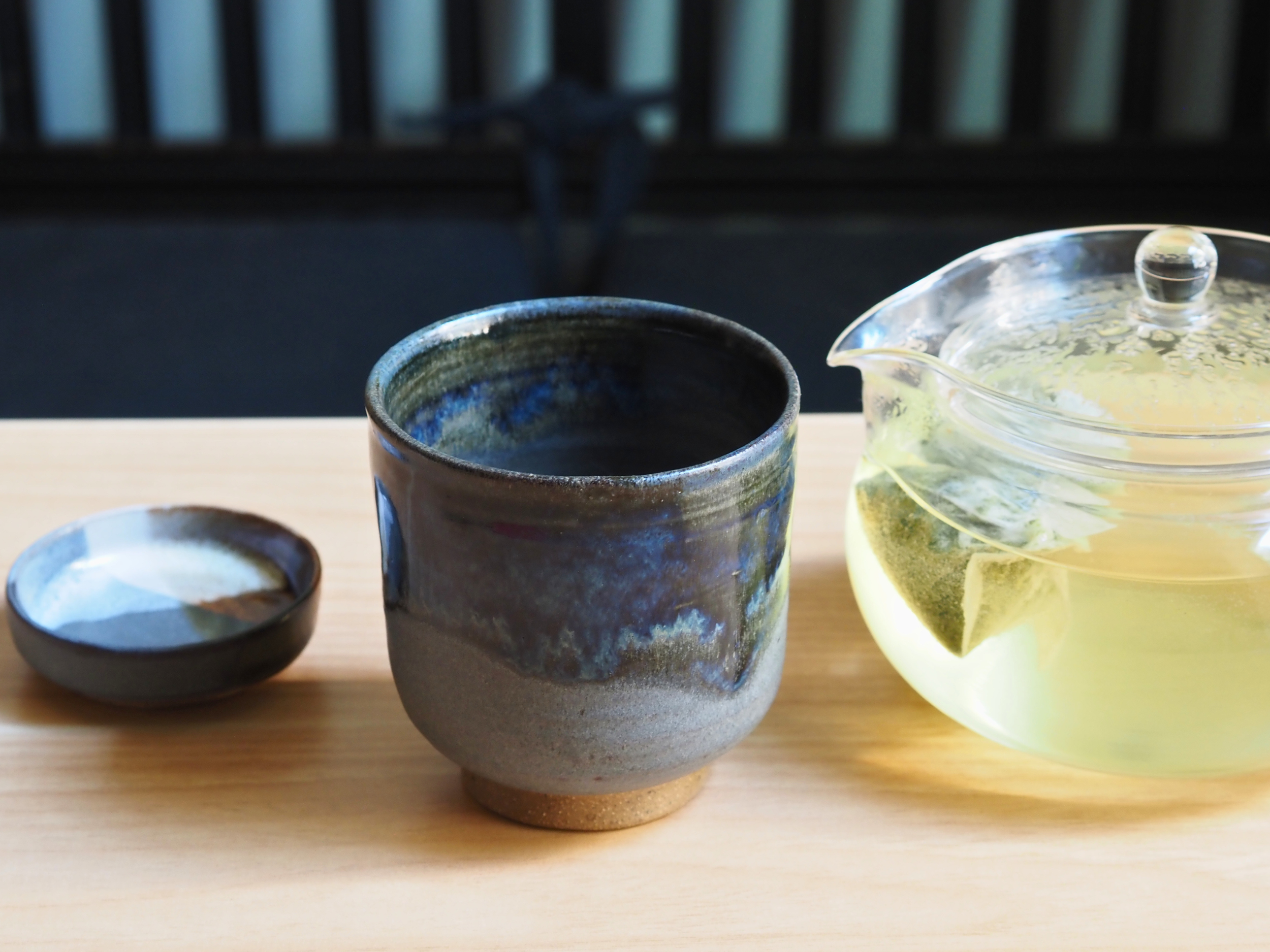
A gray and blue yunomi with a glass teapot
Yunomi, the perfect everyday tea cup
While the distinction has become blurry in the last few decades, some Japanese families still own separate teaware sets for special occasions and daily life. I remember my family storing a more elegant-looking set of porcelain tea cups and a matching tea pot high up in the kitchen cabinet for special guests (like my dad’s boss or a teacher from my elementary school). That set got maybe one or two uses a year.
A yunomi is not one of those special occasion things - it’s a cup for casual, everyday use.
Yunomi vs. chawan vs. kumidashi
There are several different styles of Japanese tea cups aside from yunomi. “Chawan” (茶碗) is a more general term for cups and bowls, including, incidentally, rice bowls and matcha bowls. Direct translation of chawan is a general “tea bowl,” though in the US context, this term often refers specifically to matcha bowls.
The difference between yunomi and “kumidashi” (汲み出し) is related to the aforementioned separation between everyday life and special occasions. A kumidashi is shaped more like a bowl, sometimes with a lid, than a cylinder. It’s typically smaller than a yunomi, often made of delicate porcelain, rather than stoneware. Delicate and elegant, a kumidashi is typically used to serve a higher-grade tea to special guests.
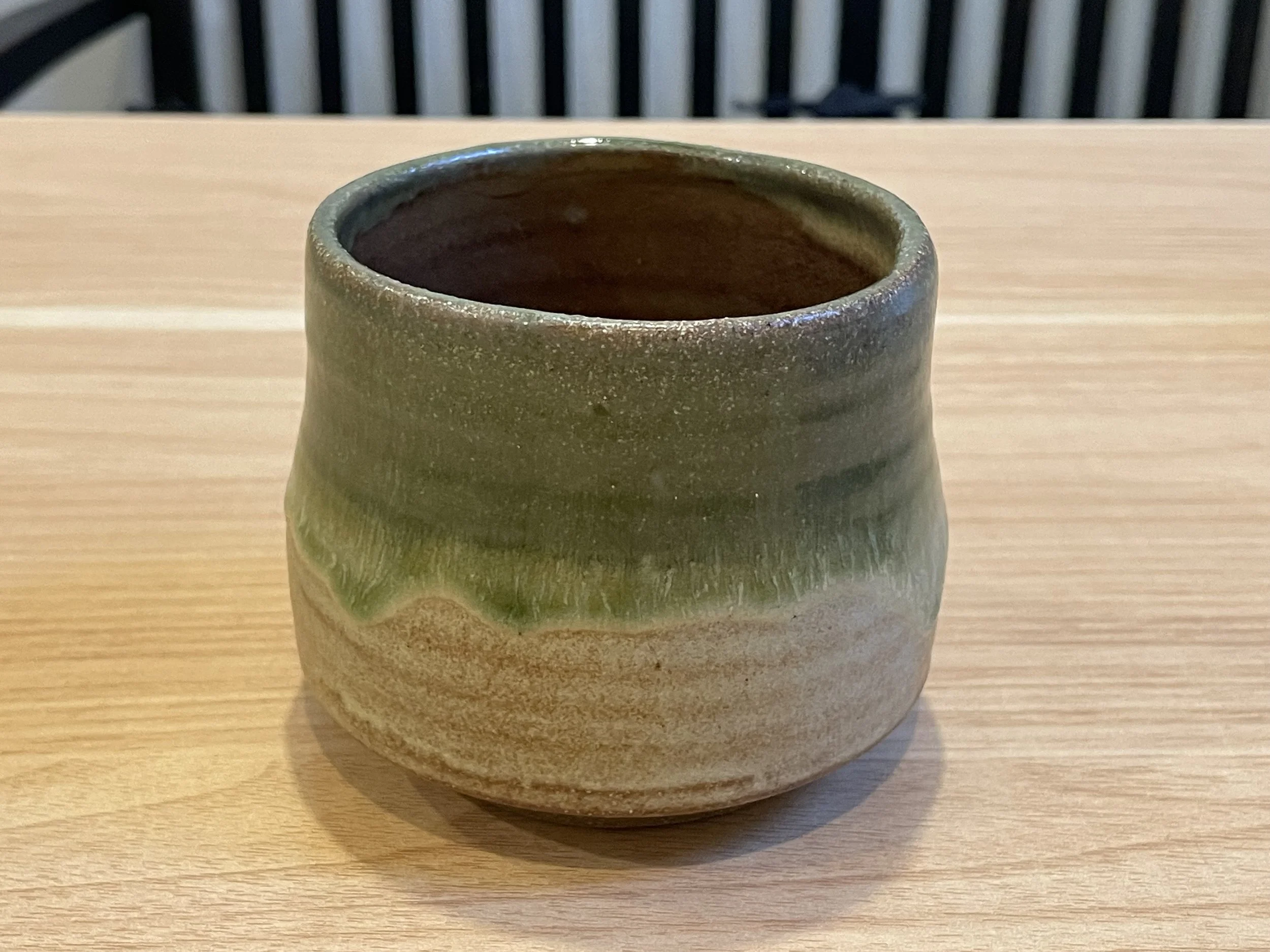
My current handmade yunomi with Oribe glaze
Your own personal yunomi
Growing up, everyone in my family had their own yunomi, as is custom. Even after 20+ years in the US, I still carry this tradition; both my husband and I have our own personal yunomi cups. It might sound a little weird, but you start to develop a bit of a relationship with your yunomi as you use it multiple times every day.
Interestingly, my relationship with my yunomi has been much stronger than that with any of my mugs, and I suspect it has something to do with the fact that a yunomi is handleless.
Holding a yunomi: tactile experience that grounds you
I hold my yunomi directly in my hand (or hands, when it’s chilly and I need to warm them up), which is a more immediate, tactile experience than holding a cup by the handle. That direct touch with my yunomi, feeling its weight and warmth, is a comforting constant.
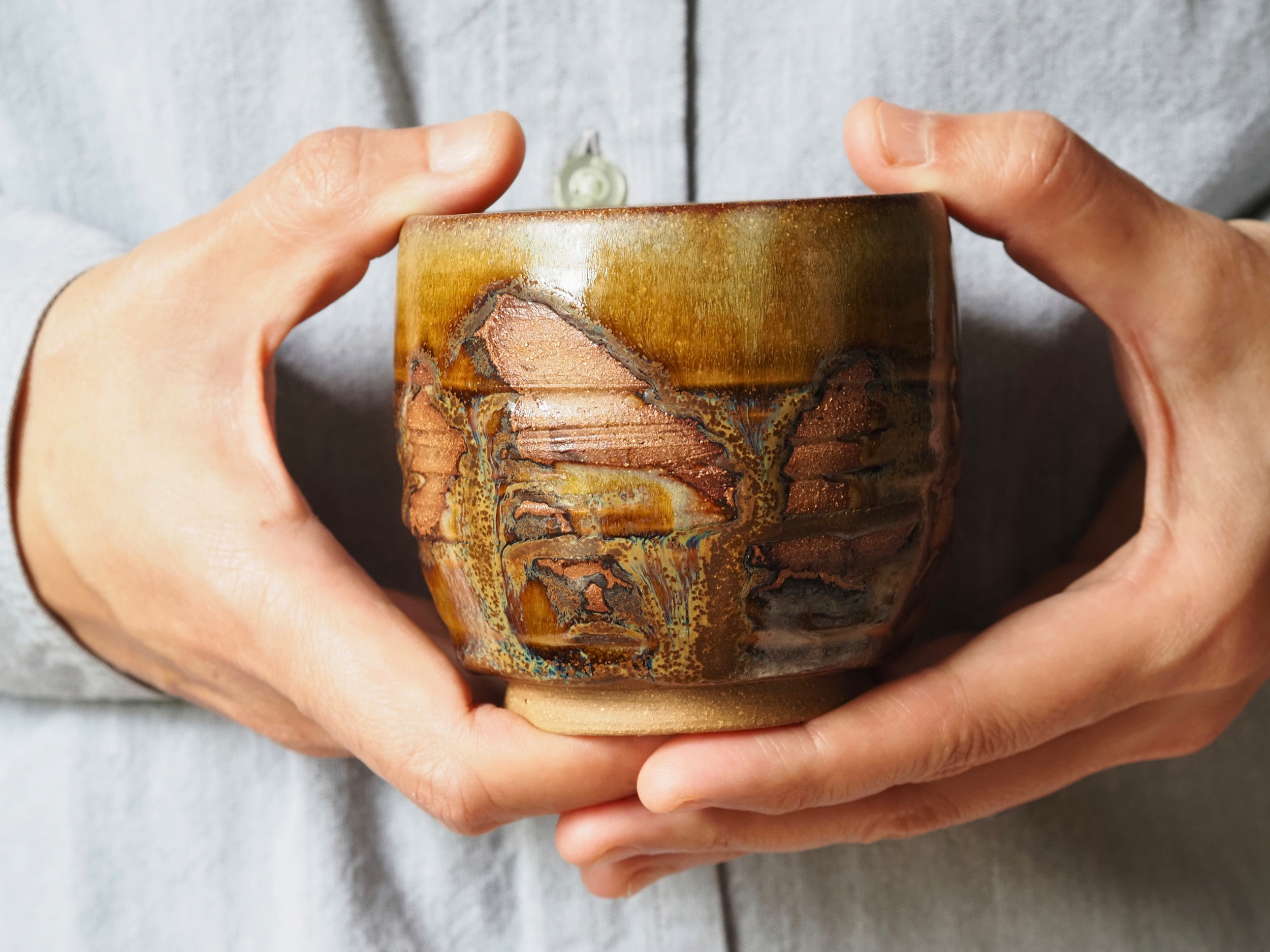
Autumn Brook Yunomi with a rough, textured surface
How the yunomi feels in your hand is key to this tactile experience, so when I’m throwing a handmade yunomi at the pottery wheel, I pay attention to the surface texture, weight and balance.
There’s no one right answer. One yunomi may be smooth, thin and lightweight; another may be rough and substantial. Both can be just right for different people, or even for the same person in different moments.
Shape and texture of a yunomi affect flavor
Just like different shapes of wine glasses affect how you experience a wine’s flavor and aroma, a yunomi’s shape and texture change what tea flavor and aroma stand out or get muted. So, there are some guidelines for matching yunomi styles to teas.
Generally, for Japanese teas, you’d want to use a smaller, porcelain tea cup with a delicate rim (i.e., something like a kumidashi) for higher-grade tea like gyokuro and some sencha, and opt for a larger, stoneware yunomi for everyday tea like hojicha (roasted tea) or genmaicha (tea with toasted brown rice).
A wider mouth and smaller size of a kumidashi is a good fit for higher-grade tea that you tend to enjoy at lower temperatures, while a larger volume and thicker wall of a yunomi keep your everyday tea warmer for longer.
How to pick the right Japanese tea cup for your tea (or not)
Here’s a general guide to picking the right ceramic cup for your tea. Hit the + sign to read the why behind each recommendation.
-
A wide-mouthed matcha bowl is necessary to whisk the matcha powder. Matcha bowls are also thicker-walled and sturdy, so they don’t fly away when you whisk, and are comfortable to hold with both hands for sipping.
-
Gyokuro has a delicate aroma and low steeping temperature that benefit from the thin, wide mouth of a kumidashi cup. The delicate feel of porcelain also compliments the elegance of this higher-grade tea style.
-
Description text goes hereSencha covers a wide range of tea grades, from everyday tea to refined, semi-special teas. I’d use kumidashi for more delicate sencha varieties, and go with yunomi for sencha with more robust flavors and aromas that steep at higher temperatures.
-
Hojicha, roasted green tea, has a wonderfully toasty, deep tea flavor, sometimes accentuated by smoky notes. A true everyday tea, hojicha is most comfortable in a big yunomi for continued sipping.
-
Similar to hojicha, genmaicha is an everyday tea with robust tea flavor that’s accented by toasty, sweet roasted brown rice. Yunomi’s casual feel and large volume make it a good fit for drinking genmaicha.
That said, I have to confess: I use my yunomi for a lot of drinks other than sencha or hojicha - my morning coffee, Earl Grey, Darjeeling, jasmine tea, oolong, iced latte (yes, iced latte) - you name it, I’ve probably had it in my yunomi. I might draw the line at alcoholic beverages, but otherwise, a yunomi is a wonderfully versatile cup.
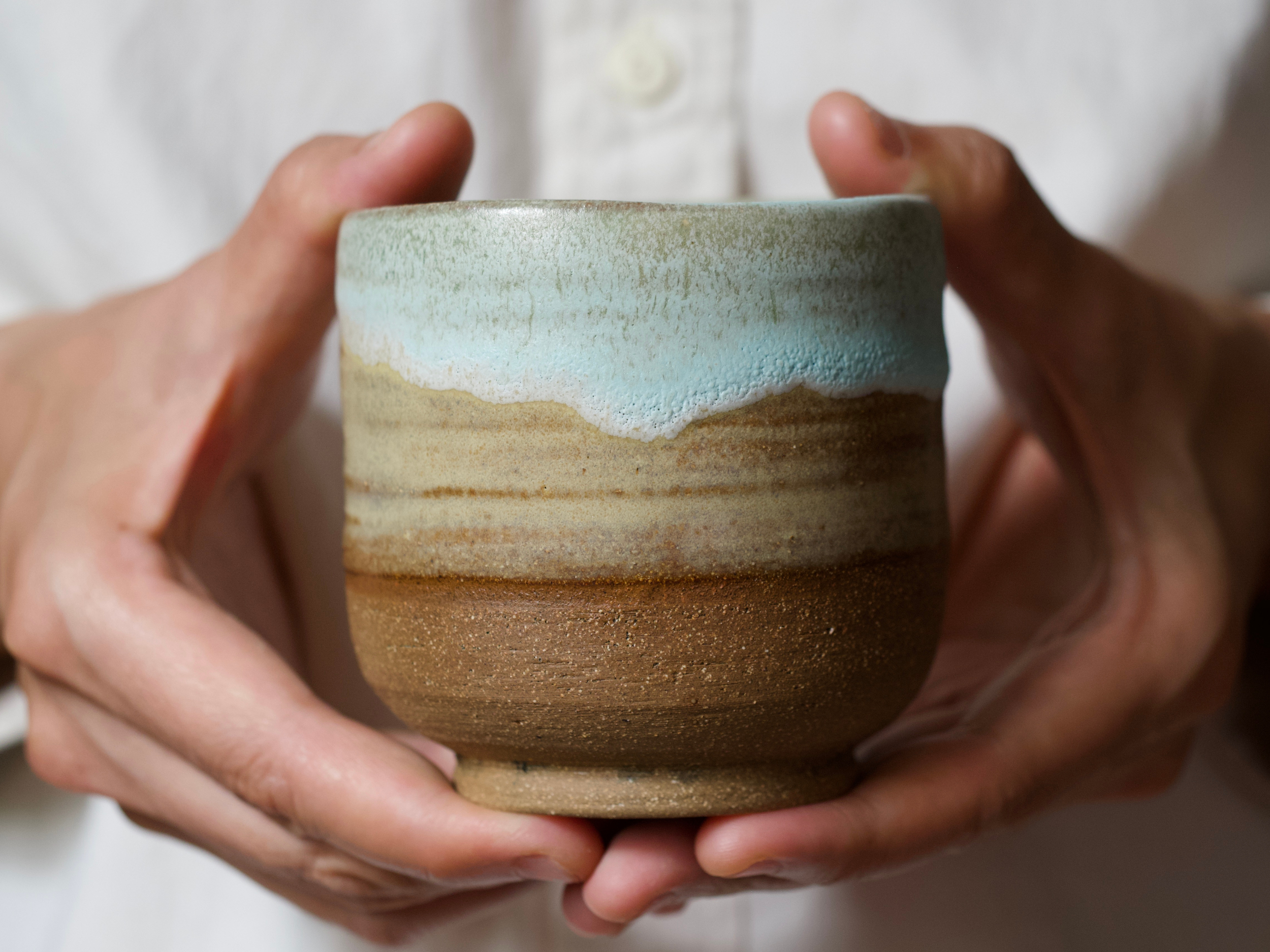
Sand & Sea Foam Yunomi also has a textured surface
What to look for when buying a yunomi
Yunomi choice is personal, and honestly, it’s best to pick your yunomi from a local store, in person, where you can pick it up and feel the weight, texture and shape. It’s harder to know which one is “the one” when you’re shopping online.
But here are a few things you can think about:
Shape: This is a personal preference, but some yunomi cups have completely vertical, straight walls, while others are more rounded in the middle, giving them a more gentle form.
Wall thickness: Because you hold your yunomi cup directly, a slightly thicker wall is a good idea. Too thin, and it can be difficult to hold it comfortably when your yunomi holds piping hot tea!
Size: Do you like to take the moment to pour tea from a tea cup? If so, you might want a smaller yunomi. If you’re like me and drink a lot of tea or coffee throughout the day, a large yunomi like this one may save you some trips to the kitchen.

An extra large yunomi can keep you fueled for longer
Weight: If you want a delicate, lightweight yunomi, porcelain is the way to go. For a more substantial, reassuring presence, stoneware yunomi is a better choice. (All my pieces are stoneware, and tend to be on the comforting side vs. delicate.)
Foot ring: You generally want a foot ring on your yunomi to keep the heat of your drink away from your table. Footless design is cute (I have a soft spot for it myself), but the heat from your hot drink can damage the finishing of your table. A yunomi with a foot ring generally also has a place at the bottom where you can easily place your pinky or ring finger for extra stability when picking up the cup. The foot ring should be smooth so that it doesn’t scratch your table.
Surface texture: A textured surface from a particular glaze or carved lines can be a nice feature that makes it easier to hold your yunomi without it slipping out of your hand.
Yunomi FAQ
Can you use yunomi for coffee?
Yes, you can use yunomi for coffee. I’m a bit of a coffee snob, and I still use my yunomi for my coffee. Is it possible that I’m missing out on some notes of Yirgacheffe (my favorite variety) because of this rogue vessel choice? Maybe. But coffee mugs are generally cylinders, much like a yunomi - so I doubt too much is lost. Try it and see if you like it!
Can you use yunomi for Chinese teas?
Yes and no. Though I’m definitely not an expert, I know that traditionally, Chinese tea is enjoyed in tiny porcelain cups in multiple rounds of steeping and pouring where you compare the different notes that come through in each steeping session. So, from that point of view, drinking Chinese tea in a big yunomi isn’t the right way.
However, if you are, like me, drinking oolong or jasmine tea brewed in a big pot throughout the day, I think yunomi works perfectly fine for Chinese tea, too. It depends on what kind of experience you’re looking for!
Can you use yunomi for black tea?
Black tea like Assam, Earl Grey, etc., are typically served in wider-mouthed cups that aren’t as tall and narrow as a yunomi. So, using a yunomi for black tea might bring out different flavors and aromas than you’d find with traditional tea cups.
If you typically use a cylindrical mug for your black tea, though, by all means, try using a yunomi and see if you like the experience! The shape is similar enough that I doubt your black tea is ruined by a yunomi vs. a mug.
Do I need to do anything special to care for my yunomi?
Usually, you don’t need to do anything different to take care of your yunomi. Some pottery styles can benefit from special care, like soaking it in water before your first use (for “kannyu” glazes) or rubbing it with a baking soda paste occasionally (for porous glazes that can pick up pigments). If that’s the case, your yunomi should come with specific instructions.
Can I microwave handmade yunomi?
This depends! It’s best to follow the yunomi maker’s guidance. I microwave mine all the time to reheat tea (Gasp! Blasphemy! Call the police!!), but if yours has a metallic paint as a decorative accent, for example, that would make your yunomi not microwave-safe.
Is a yunomi dishwasher-safe?
This also depends on how it’s made, and how fragile it is. It’s best to follow the yunomi maker’s guidance. FWIW, I hand-wash my yunomi, mostly out of habit.
What is a “meoto yunomi”?
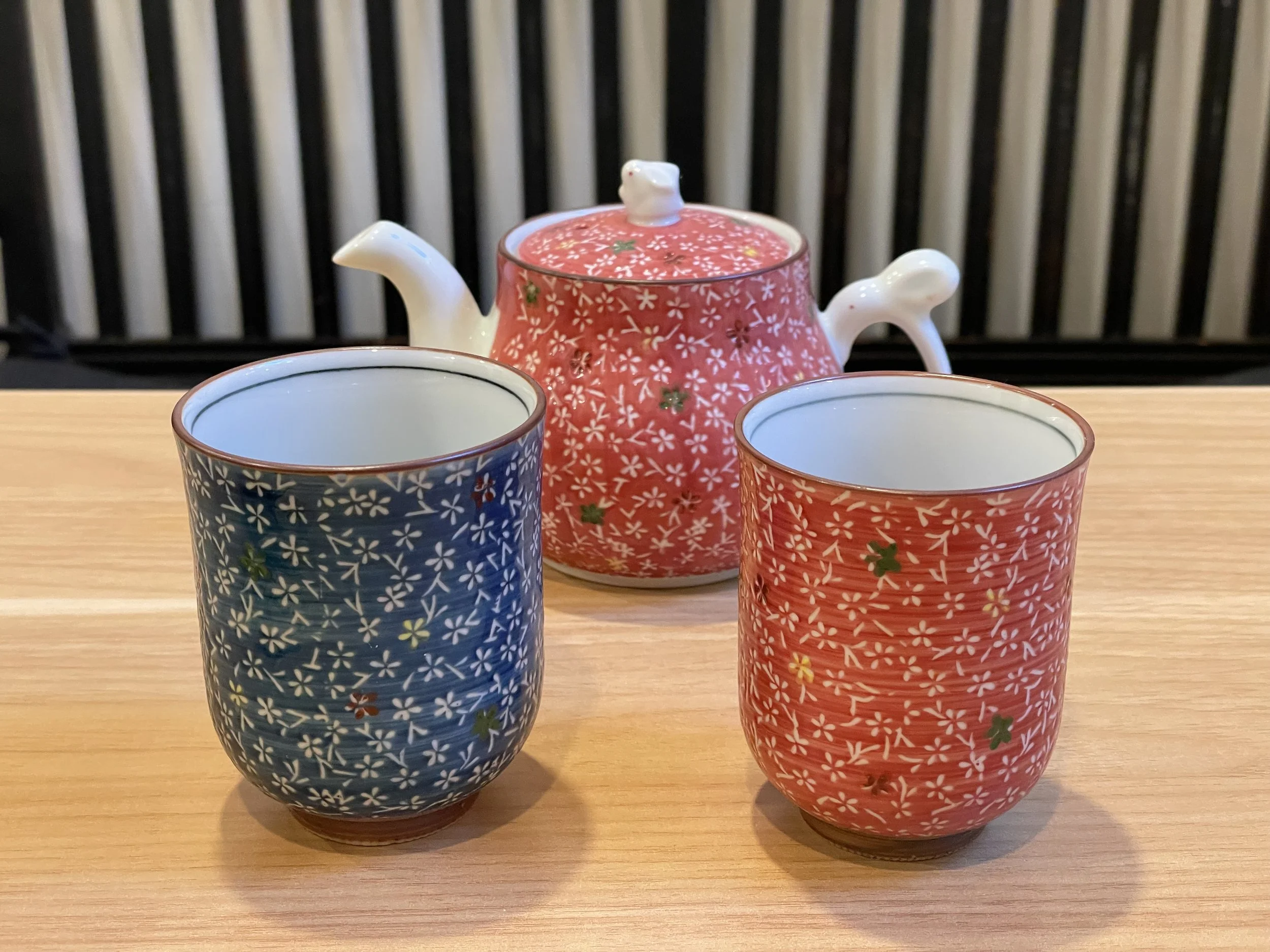
One example of a meoto yunomi set
“Meoto yunomi” (夫婦湯呑み), or more typically meoto chawan (夫婦茶碗), is a pair of matching yunomi cups designed for a couple. Unsurprisingly, these sets are often gifted at weddings or anniversaries.
Though I find the concept endearing, these meoto sets are, unsurprisingly, heteronormative in a vast majority of cases. And it’s right there in the name; “meoto” means “husband and wife”.
On a more practical level, I also find it irritating that these sets assume a man needs a bigger portion than a woman. We’ve had several meoto tea sets gifted to us, and I’ve always stolen the “man” cup, because I need a lot more tea than my husband does to feel satisfied.
On my list of things to add to my handmade Japanese pottery shop: a couple’s yunomi set that doesn’t assume any of that nonsense! (I suppose we may need a “pick however many” polyamorous set, too.)
